

Should You Clean an Airplane Windscreen Before Every Flight
By Len Litton
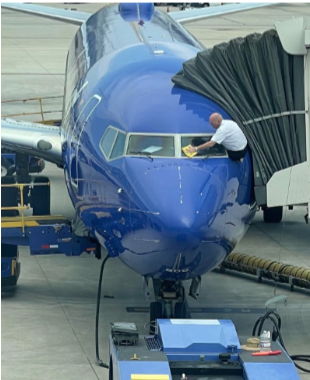
Flying safely has a lot to do with the "little things" such as checklist discipline, maintaining centerline, staying ahead of the airplane, and ensuring that before each flight the aircraft's windshield is clear of bugs, dirt, and grime. Flying with a dirty windshield can have negative consequences during all phases of flight. One of your preflight checks should be to check the windshield for contamination and make a judgment about whether or not it should be cleaned. Grime, dirt, and bugs on the windshield reduce your forward visibility, which is the last thing you want when flying a hundred miles per hour through all kinds of weather. Depending on the angle of the sun, you might even run into significant glare characteristics that make it impossible to see outside entirely. The more contamination on the windshield, the harder it is for the surface to clear drops of rain or mist. In the worst of cases, the drops of rain or mist will essentially "stick" to the windshield instead of rolling off like normal.
Regular cleaning with approved materials, such as specialized cleaners like Prist and microfiber cloths, helps remove contaminants that, over time, can cause haziness and necessitate expensive replacements. Take a look at the picture … if the professional airline pilots think a clean windshield is important, maybe you should too!
Crossword Challenge
The Go/No-Go Decision
Every pilot has faced it: the moment just before engine start when you ask yourself, "Do I fly or not?" It's a question that may seem simple in the comfort of your living room couch, but in truth, it's rarely a single, definitive moment. Weather changes. Equipment issues appear. Fatigue creeps in.
By the time you reach your destination, you've already made dozens of go/no-go decisions. Some of those may have been conscious decisions, but some are instinctive. You've reviewed weather minimums, personal minimums, fuel requirements, alternates, and contingencies. If everything checks out, you "go." If not, you "no-go." But real-world flying is rarely that clean. Factors change rapidly in the en-route environment: a forecasted ceiling drops, a line of showers develops along your route, or ATC reroutes you through unfamiliar airspace. Even when you're flying VMC, think like an IFR pilot. Practicing IFR procedures consistently improves situational awareness, flight deck management, and decision-making. It keeps your skills sharp for when the weather deteriorates unexpectedly, and it forces you to engage with the tools and resources that support informed decisions: forecasts, charts, ATC communication, and avionics. Every stage of flight is a chance to evaluate, adjust, and make smarter decisions.
Imagine departing VMC for a short cross-country, only to encounter scattered clouds that slowly close in. Your first instinct might be to push forward—the old binary "go" thinking. But if you frame the flight as a series of continuous assessments, you see options: climb, divert, hold, or even return. By breaking the decision into smaller steps, you reduce risk and maintain control.
This approach mirrors real IFR operations, where pilots constantly evaluate: alternate airports, minimums, fuel state, aircraft performance, and external pressures. Every small decision compounds into a safer outcome.
Source: Sporty's IFR Focus Fast Five
Checklist Usage: Building Safe and Consistent Habits
Effective checklist usage is a cornerstone of safe flying and strong instruction. As instructors, we should be diligent in reinforcing proper checklist habits—starting with preflight and ensuring students always have the checklist readily available in hand, not tucked away or "memorized." This builds discipline early and prevents missed items.
There are two primary methods for using a checklist: Read-Do-Verify and Do-Verify. In the Read-Do-Verify method, each item is read, completed, and then confirmed before moving on—ideal for students and critical phases of flight. The Do-Verify method involves completing flows or memorized actions first, followed by a review of the checklist to verify nothing was missed—commonly used once proficiency is established.
No matter the method, the goal remains the same: consistency, accuracy, and safety on every flight.
Congratulations to Our Students!!!!
Checkride Pass: Tyler Cottrell - MEI, Andrew Scannell - IRA, William Lipscomb - MEI, Cody Arnold - IRA, Kayla Collins - CFII, Reed Dugger - PPL, Derek Paci - CPL, Ryan Oberstar - IRA, Marcello Araya - CPL, Caleb Whiteley - CFII, Colton Sword - CFI-I
Student Solo: Peyton Stefan - 1st solo!
Student Spotlight: Colton Sword - CFI-I
Annabel Holmes & Andrew Scannell are local scholarship recipients, congratulations!
Student Survey: Click Here or Scan QR Code

Ecclesiastes 3:14 "I perceived that whatever God does endures forever; nothing can be added to it, nor anything taken from it. God has done it, so that people fear before him."