

Safety Chat
By Len Litton
Safety…you hear that word frequently in the aviation business and it certainly is a very important aspect of what we do at USAeroFlight. But how do you define it? We must think about "safety" without just saying the words and going on about business as usual. We need to think about "safety" as a "value" rather than a priority and an "outcome" that is part of a deliberative process that minimizes risk across all operations. Exposure to hazards is a part of life and certainly a part of general aviation and risk mitigation is at the heart of achieving safe outcomes.
So, you ask where do we go to learn about risk mitigation? Well, the FAA Risk Management Handbook (new and improved for 2022) is an excellent place to start. If you haven't read it or haven't encouraged your students to read it, you are leaving them unprepared for a career in aviation. For starters, keep in mind the four principles of Risk Management: accept no unnecessary risk; make risk decisions at the appropriate level; accept risk when benefits outweigh dangers (costs); and integrate risk management into planning at all levels. It's not "stick and rudder" skills that get most aviators in trouble, it's the inability to recognize hazards and properly mitigate the risk that they present to safe outcomes. Fly Safe!
AC 61-134 - Controlled Flight into Terrain Awareness
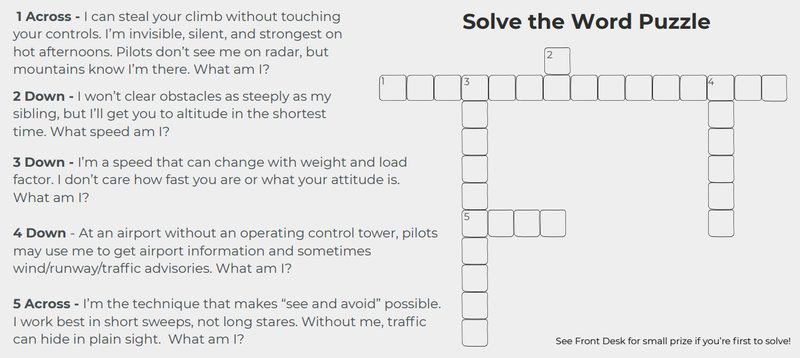
Controlled Flight Into Terrain (CFIT) accidents occur when an airworthy aircraft, under pilot control, is unintentionally flown into the ground, water, or an obstacle—often with no prior loss of control. These accidents are rarely caused by a single mistake. Instead, they result from a chain of human, environmental, and performance factors that quietly erode safety margins. One of the most underestimated contributors—especially for light training aircraft—is density altitude. Density altitude is pressure altitude corrected for nonstandard temperature (and humidity). As density altitude increases, aircraft performance decreases dramatically: Reduced engine power, Less propeller efficiency, Less wing lift. Resulting in longer takeoff and landing distance and decreased rate of climb. Even at airports near sea level, hot summer temperatures can produce density altitudes equivalent to several thousand feet above the field elevation. For a normally aspirated trainer like a Cessna 172, climb performance may be cut in half compared to book values at standard conditions. A particularly dangerous trap is "performance expectation bias" — assuming the aircraft will climb the way it usually does.
CFIT prevention starts on the ground. As instructors and students, we can normalize behaviors that build safety margins:
- Verbalize density altitude and expected climb during briefings
- Discuss terrain and obstacle departure strategies
- Encourage conservative go/no-go decisions
- Takeoff and Landing Distance Calculations per 91.103
CFIT accidents are preventable. Understanding how conditions affect climb capability, planning escape routes, and maintaining situational awareness can turn a potentially dangerous situation into a routine flight.
In aviation, the safest pilots are not the ones who can out-climb terrain — they are the ones who never need to try.
Instructor Shout Outs
Tyler Cottrell got his Multi Add on!!
Blue Skies and Tailwinds
We extend our sincerest thank you to Andrew Mabe, Director of Maintenance, and Amber Mabe, Assistant Director of Maintenance, for their outstanding dedication and service to USAeroFlight. We wish them both continued success and blue skies ahead.
Welcome Aboard
Welcome aboard to our newest instructor! Caleb Whiteley - CFI
We also want to welcome our new Director of Maintenance! - Jim Parvis
CFI Corner
How do we perform the Emergency Descent Maneuver and what does the ACS say?
The ACS doesn't specify in detail how to perform this maneuver but at USAeroflight, we have a standardized procedure that gives us the maximum rate of descent that meets ACS and is consistent across the school. Keep in mind this is a self clearing maneuver that can be applied to multiple different scenarios.
See the flow below:
- Carb heat–On
- Throttle – Idle
- Look 90° in the direction you're turning while slowing down
- Roll into a steep bank toward cleared area (ACS says 30-45 degrees bank)
- Pitch for descent at 120 KIAS (approx. -12°)
Congratulations to Our Students!!
Checkride Pass:
Aidan McKinney - IRA
Kirill Kolesnikov - CFI-A
Tyler Cottrell - Multi Add-On
Caleb Whiteley - CPL & CFI-A
Harrison Sims - Multi Add-On
Student Survey:
Click Here or Scan QR Code

Isaiah 40:31 "But they that wait upon the Lord shall renew their strength; they shall mount up with wings as eagles; they shall run, and not be weary; and they shall walk, and not faint."